Saturday, February 27, 2010

RAPTOR ROAD TRIP RECAPS

The Eagles, Owls, Hawks, and Falcons of the Northern Colorado Front Range


The winter months bring great raptor watching on the front range with many species checking out nest sites and beginning their courtship rituals. Along the back roads of Weld County and Bolder County north of Denver and midst the spreading sprawl of urban neighborhoods mixed with farms and open space, we found an abundance of Eagles, Owls, Hawks, and Falcons. Our expert guides Harold and Betty Oliver of the Audubon Society of Greater Denver led our group to raptor hot spots and produced a total of 84 raptors including 15 Bald Eagles, 2 Golden Eagles, 43 Red Tail Hawks, 7 Ferruginous Hawks, 2 Great Horned Owls, 12 American Kestrels, and 3 Northern Harriers. It was a great day trip and we plan to do it again on April 18th to check on the nest sites to see how the Eagles and Owls are doing. We hope to see Ospreys by then as they should have returned from South America.


A lone Red Tail Hawk uses a idle oil pump as a pedestal to survey its territory. Click here to see a Red Tail in flight.


Our Birding group a one of many stops looking at raptors on display in their natural habitat.


Many on the road trip took advantage of the photographic opportunities.


These two eagles were close to a nest site in Weld County. We saw them a year earlier on a another road trip. Click on the picture and see a digiscoped video of them watching over a field with rabbits and other rodents. Digiscoped with a cannon point and shoot camera on a Swarovski spotting scope
from 1/4 mile.


This digiscoped Great Horned Owl is on eggs that will hatch soon. We expect her chicks will be available to observe by April. We plan a "nesting" road trip on April 18 to see them. Click here or on the picture to see chicks we observed last year near Chatfield State Park


Our very esteemed Raptor Road Trip leaders- Harold and Betty Oliver of The Audubon Society of Greater Denver. You can do other trips sponsored by the Olivers and ASGD by visiting denveraudubon.org


We were lucky to get close up views of several Ferruginous Hawks. They are the largest of all hawks and have been considered to be included in the family of eagles.


Click here and on the small picture below to view a short Ferruginous video


We came across this cooperative Bald Eagle sitting on top of a slag rock pile.


We invite all of our Raptor Road Tripper's to share some of their pictures with us. We will give credit and links to any web site promoting pictures of birds and wildlife in their natural habitats. Send your pictures to frontrangebirding@gmail.com.


Sunday, February 7, 2010

Here is more on our Front Range Birding trip to the Northwest Coast in January. Our trip was with Partnership with International Birding http://www.pibirding.com/. Our trip yielded 114 species including 32 lifers for me. It was quite the winter trip for great photos and digiscoping. We owe Harry Fuller our expert guide all of our appreciation for leading us to all of our finds. Check out Harry's blog pibirding.wordpress.com


Check out this youtube video of a Black Oystercatcher foraging


Bald Eagle


Check out this youtube video of a Winter Wren defending his territory


Sandhill Cranes over Sauvie Island.


Harlequin Ducks on the Olympic Peninsula


Barrows Goldeneye


Sunday, January 24, 2010

Here are several pictures from our Northwest
Birding trip.

Our intrepid group on a beautiful sunny Oregon afternoon. Trip with our expert guide Harry Fuller of Partnership with International Birding. More photos and trip discription can be viewed at http://www.pibirding.wordpress.com/.


Black Oyster Catcher on Haystack Rock at
Cannon Beach, Oregon. digiscoped with Swarovski 20x60 ATS HD scope
Right is Haystack Rock


On the beach with scopes and digiscoping in
Oregon.


Mt Saint Helens, WA
Below is part of a large group of Sandhill Cranes.


Many Dulins were seen every day at surfs in
Oregon and Washington. digiscoped with Swarovski
ATS HD scope.
Pictures taken with Leica CLux 3 and VLux cameras.

Friday, January 22, 2010


Just one day into our birding tour of the Northwest in the dead of winter. Some say we are nuts to do such a thing but the fact is it is a great place to bird as many shorebirds, ducks, and raptors chose this food rich relatively mild weather environment to overwinter in. Check out here some of the pictures of our first day that produced 60+ species today and several “lifers” for me. More to come.

Thursday, November 12, 2009

New Swarovski Binoculars and Red Tail Hawk

Today I received my new pair of Swarovski EL 8.5x42 WB binoculars, which also included a snapshot adapter for taking digital pictures with the binoculars. Not five minutes after opening the box, I looked out in my backyard, and saw a red-tailed hawk sitting in a tree! What a perfect opportunity to try out my new toy. I grabbed the binoculars, adapter, and my Canon PowerShot A590IS camera. Here's the first pic I got -


Not bad! The hawk shortly flew down to the ground and kicked some leaves around.


Something scared him into a tree then, and I got these great pics -


Here's what it looked like without the magnification from the binoculars and adapter -


Makes a big difference. The hawk then flew over my head (!) to another tree and hopped around trying to get a better view of a squirrel. Eventually a bunch of blue jays landed in the tree and started harassing it, even running into it, until it had enough and flew away. I was so glad I had the chance to try out my new Swarovski binoculars and look forward to getting more practice with the snapshot adapter. This red-tailed hawk made species #22 for my yard list.

You can see all the pictures I took, good and bad, here: http://www.picasaweb.google.com/frontrangebirding/RedTailHawk#

Thursday, October 22, 2009

Digiscoping Workshop 2009

Always busy but the birding buzz this past Sat-Sun-Mon Oct 10-11-12 was exceptional at FRBC even if the weather did little to cooperate. On Saturday we held our first Optics workshop delving into the art of digiscoping at the South Platte Park and the Carson Nature Center. All toll 58 nature photographers braved snow, wind and 20 degree weather to gather in expert advice from the masters from Swarovski, Leica, Zeiss, Vortex, and Nikon.

Clay Taylor presents digiscoping at the Carson Nature Center

Our lead instructors Clay Taylor from Texas, Jeff Bouton from Florida, and Bill Schmoker of Denver were fantastic in their presentations and demonstrations of the various spotting scopes, cameras, and binoculars. Even with harsh weather conditions much was learned from the classroom, field work, and duck blind. We observed over 150 ducks, grebes, and shorebirds from the Carson Center’s duck blind and on the trails winding along the South Platte River.

Bill Schmoker talks technique on wildlife and birding photography


People attending were very appreciative of the great facilities provided by the South Platte Park. We highly recommend the excellent birding to be had year round in this close in Denver City Park.


Equipment demonstrations of Swarovski, Leica, Zeiss, and Vortex in 20 degree weather!


Leica's Jeff Bouton works one on one with attendees.

Following the Saturday digiscoping workshop, on Sunday I participated in the annual “Big Sit” bird watch at the Heronry Overlook in Chatfield State Park. I was only able to do about an hour late in the day of this dawn till dusk event as work at the store got in the way. However I was pleased to see our out of state experts Clay Taylor and Jeff Bouton help out along with Bill Schmoker. The day was still cold but not as overcast as Saturday and the attendees almost broke a record for species counted. I believe over 65 were seen by the time I left shortly before sunset.


The Chatfield State Park Big Sit at the Heronry Overlook


The Big Sit is a national event sponsored by the Cornell Lab of Ornithology. Each state has several and individuals can even establish their own to report findings. The Chatfield Big Sit is hosted by the Denver Field Ornithologists (DFO) and is organized by DFO member Joey Kellner. It is in its 7th year and is a great opportunity to contribute while honing your birding skills. The public is welcome to look into the fun event next year.


On Monday I was privileged to join Clay Taylor on a birding adventure in the Rocky Mountain National Park. We started out early from Littleton at 5 AM had breakfast in Lyons and promptly entered the East Gate around 8 AM. The trail ridge road was closed for the winter but we got around the east part of the park pretty good. Two herds of elk were roaming the meadows and we practiced some digiscoping. I got a few shots of them as well as video of Clarks Nutcrackers foraging some Ponderosa Pines. Clay, being from the East, enjoyed seeing and photographing Magpies, Red Breasted Nuthatches, and Mountain Chickadees. All birds he rarely has the opportunity to see. We finished at noon and departed the park as Clay needed to catch a4:30 flight back to Texas.


Clay Taylor digiscoping Clarks Nutcrackers in the Rocky Mountain State Park

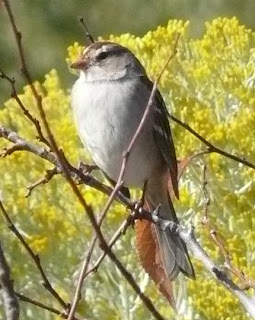
An immature White Crowned Sparrow shows himself outside the Carson Duck Blind

Wednesday, October 14, 2009

Colder Weather Brings in All the Birds

When the weather turned so cold last weekend my feeders were covered in all different species of birds. My two thistle socks and the tube thistle feeders were covered with American Goldfinches, Lesser Goldfinches, and a few House finches. The Northern Flickers, Red-shafted Flickers, Downy and Hairy Woodpeckers and a few Red-breasted Nuthatches kept the suet feeder quite busy. The Eastern Blue Jays and Chickadees were eating the peanut slipts so fast it was hard to keep up with them. They can be quite demanding at times. The Sparrows, finches, and Chickadees filled the six perches in both of my caged feeders constantly. The Mourning Doves and the one Collared Dove ate a lot of safflower. I go through a ton, at least it seems that way, of bird food during the colder seasons, but it is truley worth it to see such a variety of birds.