Saturday, September 14, 2013

Hudson Gardens 9-14-2013


Todays hike at Hudson Gardens was a great success! We had a large flock of mixed sparrows about a fourth of the way into the walk and no matter how hard we tried we couldn't get a great view of all them. They were constantly flitting up and down and left and right and back and fourth. The good looks we did get turned up several Song Sparrows, a few Vesper Sparrows, a Lincoln's Sparrow and the most exciting a Clay-colored Sparrow! Several other species went unidentified because of brief glimpses. One we thought perhaps was a Field Sparrow because it showed some rusty red on its head, a grey nape, as well as a strong eyering, no one ever got a good enough look however so it is going uncalled.


We also had another great opportunity of observe Mallard in their eclipse plumage. Now why look at Mallards you say? If you know the common birds like the back of your hand your less likely to misidentify them as something else when they change into winter or non-breeding plumage.
Male Mallards in eclipse plumage look a lot like the females but pay attention to the color of the beak and the feet and also the males will have a much darker breast than the females but often without a female right next to the male it can be hard to tell the difference. Remember female Mallards match, they have a orange (and black) beak and orange feet. While male Mallards don't match they have a yellow beak and orange feet.


We stopped at the Songbird Gardens and watched several Black-capped Chickadees, American Goldfinches and House Finches feed and chase each other around. As we made our way back to the gift shop we walked through the pine forest and enjoyed the scent of the various conifers. We passed a few very vocal Black-billed Magpies and came upon a lovely butterfly bush surrounded by butterflies. There was a Painted Lady, a Monarch and Fritillary Sp. all feeding at the same time.

 
Todays complete list of 32 species.
Canada Goose
Mallard
Double-crested Cormorant
Great Blue Heron
Snowy Egret
Osprey
Ring-billed Gull
Mourning Dove
Belted Kingfisher
Downy Woodpecker
Northern Flicker
Western Wood-Pewee
Blue Jay
Black-billed Magpie
Common Raven
Barn Swallow
Black-capped Chickadee
White-breasted Nuthatch (heard only)
House Wren (heard only)
American Robin
European Starling
Cedar Waxwing
Clay-colored Sparrow
Vesper Sparrow
Song Sparrow
Lincoln's Sparrow
Red-winged Blackbird
Yellow-headed Blackbird
Common Grackle
House Finch
Pine Siskin
American Goldfinch

Thanks for reading
-Megan

To receive monthly email of our hiking schedule call 303-979-2473 or email at
frontrangebirding@gmail.com to sign up. or just call and ask and we can sign you up on the spot.
No prior birding knowledge is necessary.

Tuesday, September 3, 2013

Birds Parts, Terms and Uses.


Buffy malars, no primary projection, white supercillium? these are all terms heard coming from the mouth of any birder at some point in time, but what does it all mean? These are all terms for different parts of the body that may be used to point out a field mark. Below is a White-throated Sparrow, which isn't common here in Colorado but their facial patterns are nicely defined.


Primary and Wing Projection can be a confusing set of terms because they both relate to the length of the primaries but the object of comparison isn't the same. Primary projection is the length of the primaries. Some birds have shorter primaries than others. Wing projection is how far the wing goes past the tail. The long wing projection (the wing going past the end of the tail) would be one indicator of this being a Swainson's Hawk. Its also good to make note of the Cere, which is the fleshy yellow spot just above the beak. This is present on all raptors.


Feather group names can be important in certain situations. The photo bellow is an exotic species, the Mandarin Duck, spreading its wings showing us all those lovely coverts. 

 
The black lores on this bird tell us its a male Yellow-breasted Chat
An eye ring is a white outline around the eye.
 They can be found in some flycatchers,
 warbler, kinglets and many more.
This McGillivray's Warbler is showing a broken eye ring.

Notice the complete eye ring on this Field Sparrow
 
These are just a few of the really common ones if you can't read one of the photos let me know and I'll enlarge it. There are many more terms that can be applied to parts of the bird that aren't used in everyday situations but are still interesting. If anyone is interested in knowing some more specific terms I can create a part 2.
 
Thanks for reading!
-Megan


Monday, August 19, 2013

Identification Tips #1 General Tips

Least Flycatcher
 
I'll be using photos from a bird banding station because that way you can get an idea of size as well as a better view of an field marks
 
Identifying birds can be a daunting task when your flipping through you field guide trying to find a small maybe yellow-olive bird that you saw while hiking up Guannella pass. If you break down what your seeing on the bird as well as the habitat around you and the noises your hearing it can make the id process much smoother.


The book
One thing I remember doing was flipping through my favorite field guide just looking at the pictures of the birds and noticing how they are organized. This is something I recommend doing whether your a beginner or advanced. Looking through your book can give you a good idea of what your looking at in the field. but don't forget to look at the real bird while its there gather information on its plumage details and behavior, back up what you saw later looking at the book. You wouldn't want to miss views of an incredible bird looking for it in the book.


This large bird is common in urban areas and loves suet!
 Its long beak and tapered tail feathers point to woodpecker her
 red underwings/ tail spotted breast and bib point to Northern Flicker.
Her lack of a red malar (or mustache) says she's a girl
Rule out what its not/ Plumage
You can rule out what a bird isn't by many different things, plumage colors and pattern, size, shape, bill shape and size, habitat, range, behavior and time of year, once you narrow down what it isn't you can focus on the fewer option you have left.
When your looking at a bird notice its color. Is it a bright color? or a more earthy color. Notice its size. Is it larger or smaller than the typical American Robin? Does it have any noticeable features? Streaks or spots on the breast? an eye ring? light eyes, dark eyes?
If your looking at a blackbird in a parking lot with yellow eyes you have now narrowed it down to two choices! Brewer's Blackbird and Common Grackle. (unless your out east then Great-tailed Grackle is another possibility)

Habitat
Different birds live and specialize in different habitats. Familiarize yourself with the various habitats in your area and the plants and bird species of those habitats.
Here are a few along the front range

Lowland Riparian
areas of tall cotton woods and thick underbrush of chokecherry, wild plumb, and willow all along a lake, river or stream.
common birds of these areas are
Yellow Warbler
Bullock's Oriole
House Wren
Broad-tailed Hummingbird
This bird is much smaller than the flicker has a shorter bill and a striking head pattern.
 This size and "earthy" colors on this bird point to sparrow. You can see in this
 photo but he has a clear breast. (no streaks)
 the white head stripes points to White-crowned Sparrow

Scrub Oak
foothill areas covered in Gambel's Oak, juniper, Three-leaf Sumac (skunkbush) and Mountain Mahogany
often housing
Spotted Towhees
Western Scrub-Jays
Blue-grey Gnatcatcher
Virginia's Warbler

Emergent Wetland
marshy areas composed of mostly cattails or rushes
houses
Marsh Wrens
Herons (many types)
Red-winged Blackbirds
Common Yellowthroat

Behavior
Watching a birds behavior can also be an indicator of what species or even what family it belongs to.
If your watching a bird sitting upright on a branch and it suddenly flies out in a little circle and comes back repeatedly it is probably a flycatcher.
If your watching a small brown bird skulk around in the bushes while wildly scolding you, you may have a wren.

Time of year
Birds migrate. Warblers leave, orioles leave, most thrushes, many herons and blackbirds leave (Colorado that is) for more abundant resources down south. On the other hand many birds arrive in the winter as well. Raptors are much more abundant in the winter and ducks! Many different kinds of ducks winter in Colorado and they are all unique and very vibrant! Make sure when your considering a bird that it has a pretty good chance of being in your area at the present time of year.
In the late summer and fall juvenile birds outnumber adults. This makes for very difficult identification on some species such as sparrows. Be trying to find an ID consider the juveniles as they often look much different than the adults.

These are just a few things to consider when looking at a bird. Think about one at a time focusing on the bird while its in sight. You can later consider other things but its very important to look at the bird itself.

This bird is a little different. Its smaller than the flicker and smaller than the WC Sparrow as well. It has a long tail, thin bill, yellow throat, wing bars (messy wing bars) and a beautiful patter on the tail. The small size bill shape you lead you to warbler. It has a much thinner longer bill than the sparrow. From there you'd look for birds with mostly grey body and yellow throat. Hopefully you'd arrive at Yellow-rumped Warbler even though you can't see the yellow rump in this photo.


Thanks for reading! -Megan


Tuesday, August 13, 2013

Hudson Garden August 10th


On August 10th Britny, myself and 9 other people gathered at the Hudson Garden gift shop for our Saturday walk.

We saw few birds until we reached the Platte where birds activity was plentiful! Yellow Warblers are still singing and Northern Flicker's were calling from the tall cottonwoods. We made our way up the river watching the Mallards float by while discussing the males in eclipse plumage (Males with a yellow bill and orange feet while females have an orange bill and orange feet). Arriving at the bridge we glassed the water for Wood Ducks and found a single eclipsed male mixed in with 15 or some Mallards.

An adult Double-crested Cormorant sunned itself in the center of the river its jet black plumage and green eyes reflecting in the sun. While admiring this textbook adult a juvenile paddled down to a rock nearby. We noticed the overall buffy look to the juvenile compared to the adult.

We had lovely views of 3 herons species Great Blue Heron, Black-crowned Night-heron and the slender Snowy Egret.
Snowy Egret

We made our way across the river to a small adjoining pond where we watched Barn Swallows and talked about how to tell the differences between the species perched and in flight. On our way back to the coffee shop we had great views of Cedar Waxwings catching insects out above the river. We ended the day with a mystery juvenile Grosbeak on the Hudson Garden's hopper feeder. Initially we thought Black-headed and it slowly turned to doubt as we noticed a stain of red on a breast as well and red under wings as it flew past us disappearing into the locust trees. We were never able to relocate the bird but we're still leaning toward Red-breasted Grosbeak. We ended the day with 25 species.

Wood Duck with her duckling

Be sure to check out more photos on our facebook page at www.facebook.com/frontrangebirding

Canada Goose
Wood Duck
Mallard
Double-crested Cormorant
Great Blue Heron
Snowy Egret
Black-crowned Night-heron
Turkey Vulture
Red-tailed Hawk
Rock Pigeon
Mourning Dove
Belted Kingfisher
Northern Flicker
Western Wood-Pewee
Barn Swallow
Black-capped Chickadee
House Wren
American Robin
European Starling
Cedar Waxwing
Yellow Warbler
Rose-breasted/Black-headed Grosbeak
Red-winged Blackbird
Common Grackle
House Finch
American Goldfinch

Thanks for reading! -Megan

Thursday, August 8, 2013

California Coast Point Reyes


Hotel on Tamale Bay
Western Scrub-Jay
Point Reyes is famous for its variety and number of species during the migration and summer months. I wish I'd done a little more research about what places to go before getting there but I was pleased with the many interesting things we saw.  Our hotel was right on the edge of Tamale bay where my sister and I found many new creatures including barnacles (which are actually crustaceans), tiny crabs, terns and even some sort of ray that was floating just bellow the surface!
Right outside our window there were a few bird feeders that were frequented by Western Scrub Jays and House Finches.

Caspian Tern
Our first adventure at Pt. Reyes was to the lighthouse where the wind blew so hard I had to back up to the rocks to keep my balance! I brought my scope up but it was almost useless because of the biting cold wind. The birds though! It was amazing. On the walk to the light house White-crowned Sparrows sang continuously and a lone windblown Rock Wren was even singing! The stairs to the actual lighthouse where closed but the fenced look area was plenty for me.

Far bellow us tiny dots where constantly flying around, when I finally got a scope set up I could see cormorant, guillemots, and gulls all flying to and from the cliffs. For every bird I managed to identify at such a great windy, misty distance there were 20 or so that I could hardy see. The cormorants I was completely lost on. Every time I saw one I thought I could ID it would move slightly and turn into a another species. I decided I'd wait to see cormorants at a different location (and the patience paid off).

Common Murres
Cliff Side
On the right side of cliff was a large rock that held thousand and thousands of Common Murres, and hundreds were leaving at one time and hundreds were landing all at the same time. I scanned that rock and the surrounding one over and over looking for puffins and auklets but did not find any. As we turned to head back to the parking lot I glanced down the cliff one last time to attempt to count the birds on the water when a Peregrine Falcon flew by! We were all freezing at this point and decided it was time to leave. Next was Chimney Rock.

Pt Reyes Light house
Chimney rock wasn't nearly as birdy as the lighthouse but it held a breeding colony of Elephant seals and just off the shore a flotilla of Surf Scoters! While admiring the scoters Savannah Sparrows, American Goldfinches and White-crowned Sparrows sang in the fields behind us. We never actually mad it to chimney rock as it had been a long day of travel and hiking and it was time to head back.

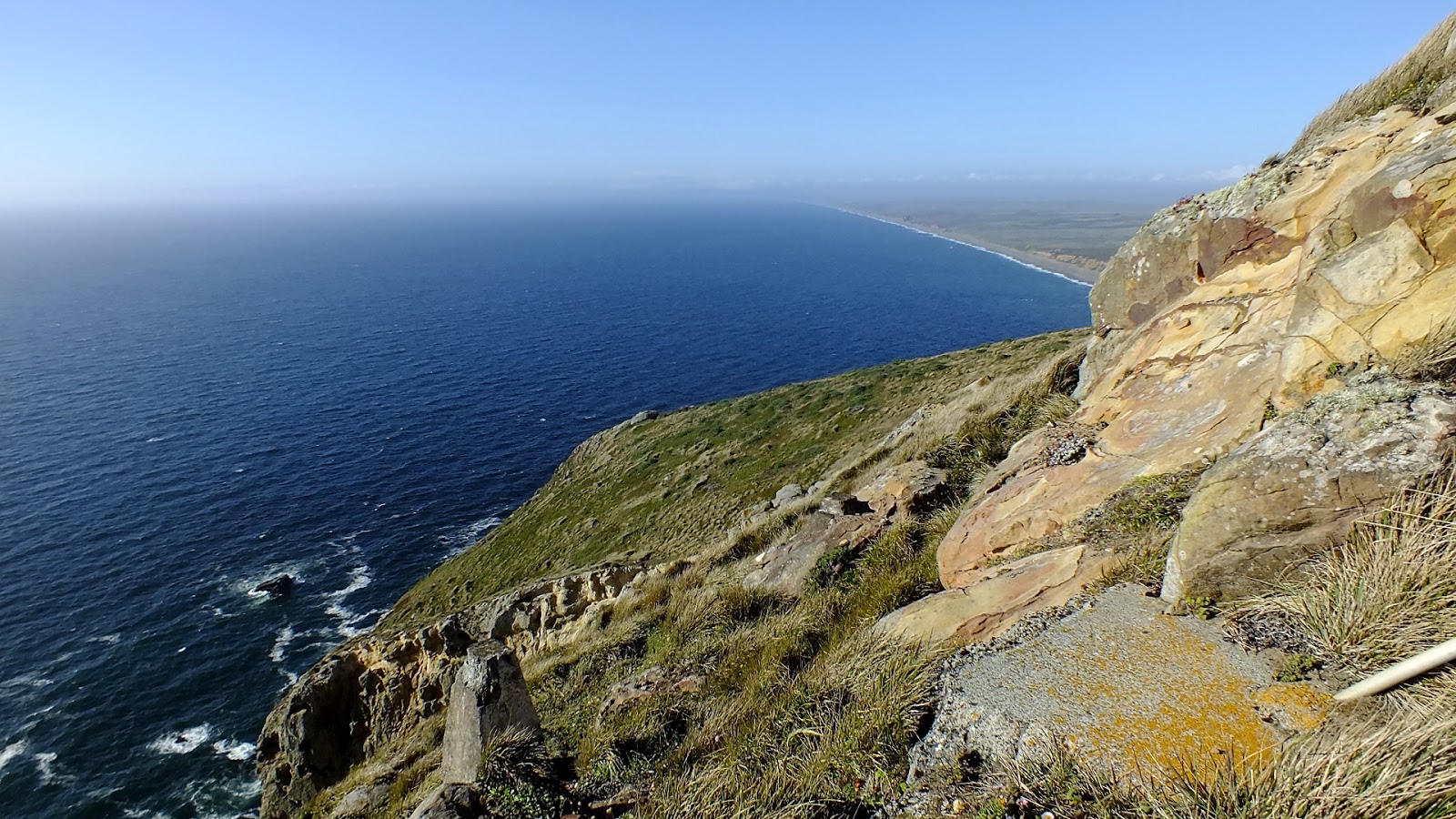
View from the lighthouse


Day two at Point Reyes was an interesting one. We'd planned on going to the banding station there but the one we found was closed because of the wind. While deciding where to go next I spotted Chestnut-backed Chickadees, Anna's Hummingbirds, Band-tailed Pigeons, and a Bewick's Wren! All while I was standing in the parking lot. While standing around one of the interns informed us of another banding station in the park that we should try. They said it was a better station and had more birds. We piled in the car and headed on over.

So far all my experience with banding stations has been through Rocky Mountain Bird Observatory. They take more of an educational stance with banding. The Pt. Reyes Station was almost strictly for scientific study. They had no table, three banders and no excited children standing around. They banded, measured, weighed and let the birds go. Fast and efficient. They had twenty to thirty birds on their hooks which is often more than we catch in a day at Audubon. It was here I saw my first Wrentits of the trip! So far I'd only heard them mocking us from the bushes. Seeing them in the hand was very exciting. 

Wrentit in the net
 Our last stop at Pt Reyes was Abott's Laggoon. It was supposedly the best spot for migrants. Of course being there in mid June I didn't see many migrants. Abbott's Lagoon was hot and a little slow. Many singing Sparrows, Savannah and Grasshopper but we didn't see very many shore line type birds.
We passed a Great Blue Heron sitting in a tree and moved onto the sandy bank where we found a strange mystery bird sitting on the shore panting. Its feet sat way on the back of its body, it was slender and had a long slightly upturned bill. I new it had to be a loon of some sort but living in Colorado I have not had the chance to get a good look at many loons. Upon returning I posted the photos to facebook (of course) and immediately it was IDed as a Red-throated Loon based on its light plumage, and upturned bill. Loons don't usually sit on the shoreline nor do they breed in California so I'm not sure what was goin on with this guy. 

Red-throated Loon

 Thanks for reading! -Megan

Wednesday, August 7, 2013

The California Coast San Fran June 2013

I meant to post this back in June when returned from California but I forgot. So this will be the shortened version based on what I remember from two months ago.

Wildlife of Chinatown
My mom sister and myself went on a trip to California this summer. We'd never been to California before so we flew into San Francisco on a Sunday morning and spent the week driving north. We visited Point Reyes National Seashore, St Helena, Sonoma, Calistoga, Mendocino wine country and my sister toured the Culinary Institute of American.

We arrived in San Francisco where I was greeted with 4 White-throated Swifts floating about the sky train. Our plan was to drive from the airport to our hotel and then head out to China Town and then Fisherman's Warf. It didn't quite go that well.

There was a fundraising race of some sort and the main road we needed to find was closed off. We drove in circles for 45 minutes trying to find the correct one way road that met up again with the road we needed. All we had was a simple map of san fran that the rental car place gave us.


Sealions at Fisherman's Warf
We were relieved to find our hotel and drop our stuff off. We bought a real map and started our journey through China Town. Now china town was not very birdy. Lots of pigeons, House Sparrows, Starlings and Western Gulls, the food on the other hand was in excess. Every shop had delicious varieties of fried or steamed dumplings, all the touristy shops overflowed with random Asiatic trinkets.

Western Gull
 

Later after a quick refresher at the hotel we made our way to Fisherman's Warf in hopes of finding some tastey seafood. The food here was surprisingly disappointing, but we got to see the sea lions and I got great views of all gulls on the boat dock. We even found a couple on the nest!

White-crowned Sparrow singing at the Warf

Thanks for reading! -Megan

Tuesday, August 6, 2013

Bonny July 2013 Part 2

The pancakes were surprisingly delicious. We put an apple in them since we forgot syrup.
We packed up our dinner supplies into the car and headed off to the other side of the reservoir to play some owl calls.
Grove by the campsite (photo by Austin Hess)

We started at the grove we'd hiked at earlier and played Eastern Screech, Barn and Great Horned but had no replies. It was still a bit light out so we weren't expecting much. We continued down the road stopping at places with thickets of willow or juniper. Our only productive sight was just outside another campsite. We started with the Great Horned and had a pretty immediate reply and then a second drawn out raspy reply...a Barn Owl! We then played the Barn Owl and got a few more answers from that guy as well. We saw a lonely great horned floating over the prairie to our left and we drove on. We drove all the way around the park playing at various places. The lack of owls was made up for by some other fun findings such as a calling poorwill, a grove filled with fireflies and large toads all over the road. We drove back to our campsite and crashed for the night.
Cicada

We arose at 5:00AM the next morning to make a breakfast of instant mashed potatoes (delicious).
We decided to drive a little ways up the road and bird the grove we camped at more thoroughly. Common Nighthawks were still "peenting" in the trees and sky around us and we ventured into the grove. We were immediately met by a song that sounded very similar to the intro of a Ruby-crowned Kinglet's song. We searched trees and bushes to find it but couldn't quite keep up with it. We were distracted by others singing. Orioles, Yellow Warblers, Common Yellowthroats, Western Kingbirds and Warbling Vireos. Also singing in a loud vibrating chorus were cicadas. We'd come across a few at this point when they erupted in a loud explosive manner from the underbrush when we passed. Once in a while they'd become entangled in the grass allowing them to be caught. We found one and examined it thoroughly admiring its size and the incredible sound it continued to produce while we held it. It was almost earsplitting if he was held facing ones ears. We let it go and continued on into the grove to find an Orchard Oriole and a Bullock's X Baltimore Oriole foraging in the apsens above our heads. We again heard the Kinglet's intro and started to follow it again. It quickly disappeared again so we headed back to the car to carry on to a new place. We started to suspect at this point that maybe our "kinglet" was a Field Sparrow. We knew Kinglets didn't breed out on the plains and it was only singing the first two or three notes of its song. Upon returning to the car we pulled up the Field Sparrow song on the ipod and decided that's what is was. We were now determined to confirm that and find the bird.
Fledgling Western Kingbird


We drove around toward the first grove of trees we'd hiked in the day before. We rolled the windows down and drove slowly so we could hear our surroundings. As soon as we heard the Field Sparrow again we stopped and jumped out looking around on the tops of trees, bushes, yucca ect. We found it sitting in the left side of a nearby tree singing its song repeatedly. We pulled out a scope and set it up and watched it sing for several minutes non stop.

Fledgling Mourning Dove
We had one more spot to stop before we had to head home. The main campground (now closed) So far we'd missed the cuckoos. Couldn't find them anywhere. No calls, no songs, no glimpses nothing. So now we were determined to find our other target the Northern Cardinal. We'd already scoured many a thicket along the road looking and listening for their presence. The camp ground turned up almost nothing, a few Black-capped Chickadees (the first for the trip) and most exciting a glimpse of a Barn Owl flying low toward the forest. No Cardinals. We did happen upon the bones of a Common Porcupine which we collected and are donating to the DMNS for their collection.

Common Buckeye

 
It was about noon and piled back in the car begin the long drive home. Bellow is the list of birds we saw or heard birds with a * shows a confirmed breeding


  1. Wild Turkey* (fledged young)
  2. Northern Harrier
  3. Swainson's Hawk
  4. Red-tailed Hawk
  5. Killdeer
  6. Mourning Dove*(fledged young)
  7. Barn Owl
  8. Great Horned Owl
  9. Common Nighthawk
  10. Common Poorwill
  11. Chimney Swift
  12. Red-headed Woodpecker*(feeding fledglings)
  13. Downy Woodpecker
  14. "Yellow-shafted" Northern Flicker
  15. American Kestrel
  16. Western Wood-pewee
  17. Western Kingbird* (feeding fledglings)
  18. Eastern Kingbird* (feeding fledglings)
  19. Bell's Vireo
  20. Warbling Vireo
  21. Blue Jay
  22. Cliff Swallow
  23. Black-capped Chickadee
  24. White-breasted Nuthatch
  25. House Wren
  26. Eastern Bluebird
  27. American Robin
  28. Brown Thrasher
  29. Common Yellowthroat
  30. Yellow-breasted Chat
  31. Spotted Towhee
  32. Field Sparrow
  33. Lark Sparrow
  34. Song Sparrow
  35. Indigo Bunting
  36. Red-winged Blackbird
  37. Western Meadowlark
  38. Common Grackle
  39. Brown-headed Cowbird
  40. Orchard Oriole
  41. Bullock's X Baltimore Oriole
  42. House Finch
  43. American Goldfinch

Thanks for reading!

-Megan